What is an Elevator Pitch?
An elevator pitch is a brief, persuasive speech that you use to spark interest in what you do or what you offer. It should be concise enough to deliver during an elevator ride, hence the name. In the fast-paced world of professional interactions, a well-crafted elevator pitch can be your key to making a lasting impression on a hiring manager. Here’s how you can develop an impactful elevator pitch tailored for presenting yourself to a hiring manager.
Creating a tailored elevator pitch for each opportunity is a must! If you don’t, you will end up doing something that will hurt your candidacy rather than helping it.
Showcase Communication Skills with an Elevator Speech
Crafting an effective elevator pitch starts with understanding who you’re talking to. When addressing a hiring manager, it’s crucial to grasp their specific interests, needs, and the context of the encounter.
- Research: Delve into the company’s mission, values, and recent achievements. Understand the industry challenges they face and their strategic goals. This information can typically be found on the company’s website, recent press releases, and through platforms like LinkedIn.
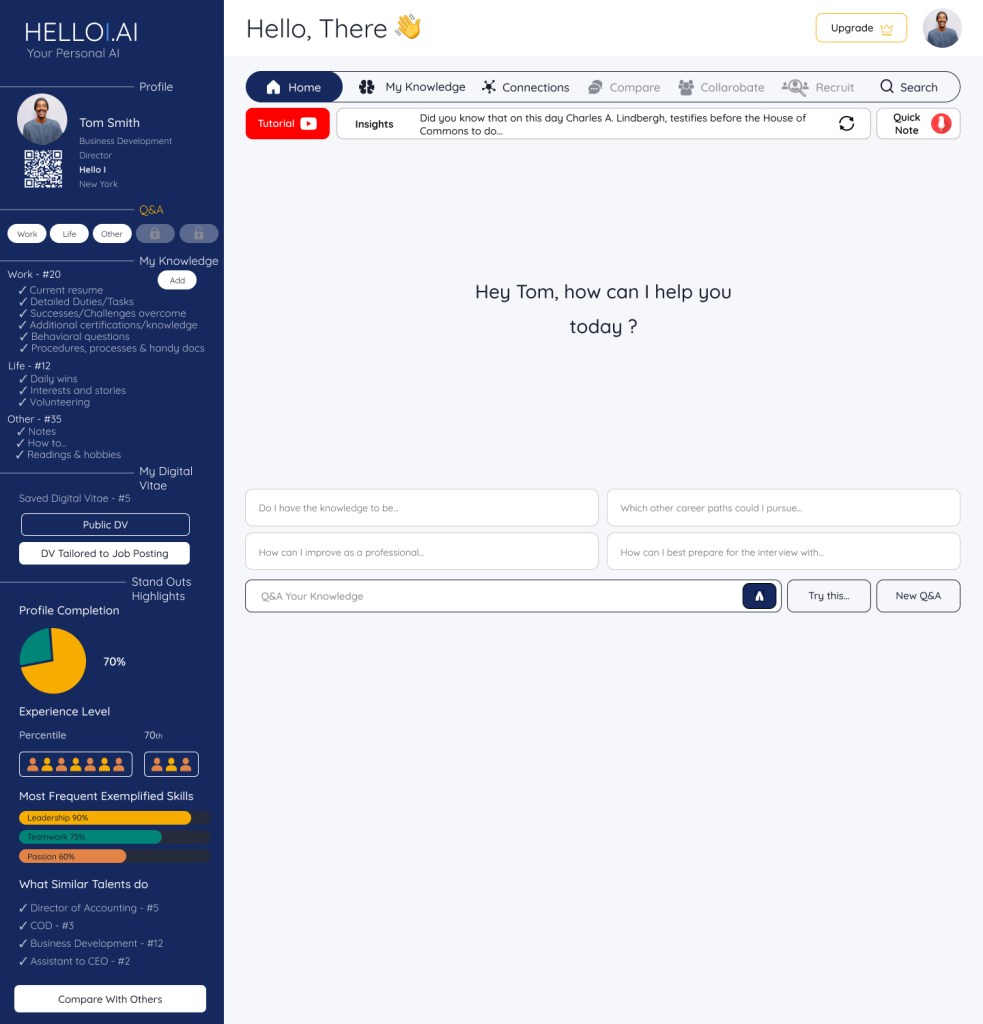
- Identify Needs: Consider the typical challenges a hiring manager in your field might face. This could range from finding candidates with specific technical skills to those who can fit well into the company culture. If you have applied for a specific job opening, now it’s the time to go back to that job description and read it REALLY carefully. Go through it more than once, understand what the mandatory skills or certifications are, and which are the most important aspects to highlight. You could also use HelloI to do it automatically for you by just adding the job description you have applied for, and the AI module specifically created by “Hello I” for that task will highlight all the relevant topics for you and automatically create your elevator pitch. Not just “an” elevator pitch, but “the” elevator pitch specifically tailored for that role highlighting YOUR specific value.
- Tailor Your Pitch: Use the insights from your research to tailor your language, tone, and content. Demonstrate that you have a solution that resonates with their specific challenges or goals. For instance, if the company is expanding internationally, emphasize your global experience and language skills.
Clarify Your Value Proposition or Personal USP (Unique Selling Point)
- Be Concise and Compelling: Your value proposition should be clear and engaging. Focus on the benefits that matter to the hiring manager. For example, if the hiring manager is looking for someone with more than 10 years of experience in the M&A world that has done also large and complex deals, you could start with “I bring 17+ years of experience in finance and M&A, having successfully managed deals totaling over $7 billion, which positions me to significantly contribute to your company’s strategic growth initiatives.”
- Answer the “Why”: Answer the question, “Why should they care?” Highlight the impact of your skills and experiences on the company’s goals. Avoid jargon and keep it simple so that the significance of your offer is immediately apparent. A good way to answer the ‘why’ is to take the job description, break it down into sentences, and think about what you can bring or have done for each of those sentences. Now prioritize the most important ones… those would be your major ‘why’ that you need to bring up during your elevator pitch.
- Highlight Unique Strengths: Mention specific achievements that set you apart. If you’ve mentored startups or have an Executive MBA from a prestigious institution, weave these into your value proposition if they are looking for someone that could “coach a team” and is “capable of fast learning”
Be Succinct and Memorable
Start with a Hook
Begin with an engaging statement or question to grab attention. This hook should be relevant to the hiring manager and the company’s needs, immediately piquing their interest. For example, “Have you ever struggled to integrate newly acquired companies smoothly? I specialize in post-merger integrations with a proven track record.”
A strong hook not only captures attention but also sets the stage for your value proposition. According to an article by The Muse, starting with a compelling question or intriguing fact can significantly enhance the effectiveness of your elevator pitch.
Unfold Your Value Proposition
Once you have their attention, succinctly explain who you are, what you do, and how it benefits the hiring manager. Focus on the unique value you bring and how it aligns with the company’s needs. Use short, impactful stories or anecdotes to illustrate your point, but keep them brief.
For example: “Over the past 17 years, I’ve managed M&A deals totaling over $7 billion, ensuring seamless integrations that have resulted in significant cost savings and operational efficiencies. In my last role at Korn Ferry, I led the integration of a major acquisition that enhanced our market position and drove revenue growth by 20%.”
Crisp and Clear
Ensure your pitch leaves a lasting impression. You want the hiring manager to walk away with a clear and memorable idea of who you are and what you offer. This means being direct and avoiding jargon or overly complex explanations. A recent article from Harvard on how to craft effective elevator pitches emphasizes the importance of clarity and brevity.
Practice, Practice, Practice
To convey confidence and polish, rehearse your elevator pitch regularly.
- Natural Delivery: Practice until your pitch feels natural and not scripted. Aim for a conversational tone rather than a robotic recitation. This helps in adapting your pitch to different audiences and situations without losing the core message.
- Feedback: Practice in front of a mirror, record yourself, or try it out on friends and family to get feedback. Use this feedback to refine your pitch.
- Control Your Delivery: Being well-prepared will help you control the pace of your delivery and avoid fillers like “um” or “uh.” A smooth delivery enhances your professionalism and makes a better impression.
End with a Call to Action
A strong closing is as important as a strong opening. Your audience should be left with a clear idea of what you want them to do next.
- Be Explicit: Clearly state what you want to happen next. Do you want to schedule a follow-up meeting, invite them to review your portfolio, or exchange business cards? Make your ask appropriate for the level of engagement and interest they’ve shown.
- Encourage Dialogue: Ending your elevator pitch with a question can be an effective strategy to encourage immediate dialogue. For example, “I’d love to discuss how my background in financial modeling and multi-project management can support your upcoming projects. Can we schedule a time to talk more?”
Elevator Pitch examples
The following are some examples of “general” elevator pitch, just to get you started. But remember to be as specific as you can and tailor your pitch to the specific job opening. If you want an automatically tailored one, you can do it by simply signing up for free to the “Hello I” AI platform.
| Elevator Pitch Example 1 – Mergers & Acquisition Professional |
|---|
| Hello, my name is [Insert Name]. With over 17 years in finance, accounting, and mergers and acquisitions, I’ve managed deals totaling over $7 billion. My expertise lies in strategic growth and post-merger integrations, having successfully led corporate development initiatives and strategic partnerships at top firms like [Example] and [Example]. One of my key strengths is navigating complex mergers and ensuring seamless integration, which I believe aligns perfectly with your company’s current expansion strategy. In my last role, I streamlined integration processes across multiple projects, resulting in significant cost savings and operational efficiencies. I’d love to bring this experience to your team |
| Elevator Pitch Example 2 – HR Professional |
|---|
| Hello, my name is [Insert Name]. Have you ever faced challenges in attracting and retaining top tech talent in a competitive market? As an HR manager with over [X] years of experience, I specialize in building robust talent acquisition strategies and fostering a culture of innovation and collaboration. In my previous role at [Previous Company], I implemented a comprehensive recruitment program that reduced our time-to-hire by 30% and increased our employee retention rate by 25%. Additionally, I introduced an employee development initiative that not only enhanced skill sets across the organization but also boosted overall employee engagement and satisfaction. With my expertise in HR strategy, talent management, and employee development, I am confident in my ability to support [Software Company]’s growth and help build a dynamic, skilled, and motivated team. |
| Elevator Pitch Example 3 – Sales Leader |
|---|
| Hi, I’m [Insert Name]. In today’s competitive software market, growing sales requires more than just hitting targets; it needs innovative strategies and a deep understanding of customer needs. With over [X] years of experience leading sales teams in the tech industry, I’ve consistently driven transformative results. At [Previous Company], I spearheaded a sales initiative that not only doubled our client base within two years but also increased our average deal size by 40%. By leveraging advanced analytics and fostering a collaborative team culture, we significantly enhanced our market penetration and customer satisfaction. I excel at creating scalable sales processes and nurturing talent, ensuring that each team member reaches their full potential while aligning with the company’s strategic goals. I’m passionate about using data-driven insights to craft bespoke solutions that address unique client challenges and drive sustainable growth. I would love to bring my experience and passion for sales excellence to [Company]. |
| Elevator Pitch Example 4 – Recent College Graduate |
|---|
| Hi, I’m [Insert Name]. As a recent graduate with a degree in Computer Science from [University Name], I am eager to apply my skills in software development and innovation to a dynamic and forward-thinking company like [Software Company]. During my time at [University Name], I completed several projects that honed my abilities in full-stack development, including a capstone project where I led a team to develop a web application that improved the efficiency of campus services by 30%. Additionally, I interned at [Previous Company], where I gained practical experience in Agile methodologies and contributed to a project that streamlined the user interface, enhancing customer satisfaction. I thrive in collaborative environments and am passionate about leveraging technology to solve real-world problems. I am particularly excited about [Software Company]’s commitment to innovation and its impressive portfolio of products. I believe my fresh perspective, combined with my technical skills and enthusiasm for learning, can contribute positively to your team. |