Understanding the Purpose of a Letter of Resignation
When it comes to resigning from a job, writing a two weeks notice letter is more than just a formality; it’s a crucial step in the process that holds significance for both the employee and the employer. This official document not only marks the end of your tenure but also sets the tone for your departure and potentially shapes your professional relationship with the organization moving forward. As you write effective Resumes, you should master also the art of writing great two weeks notice letters.
Why should you give a two weeks notice letter?
One of the primary purposes of a two weeks notice letter is to demonstrate professionalism and courtesy towards your employer. By providing a formal notification of your intention to resign, you afford your employer the time and opportunity to prepare for your departure. This can involve initiating the search for your replacement, redistributing your responsibilities among the team, or making any necessary adjustments to workflow or projects.
Research conducted by the Society for Human Resource Management (SHRM) found that approximately 76% of employers expect employees to provide a two-week notice before leaving their position (source: SHRM). Failing to do so can leave a negative impression and may even burn bridges that could impact your future career prospects.
Providing a two weeks notice letter allows for a smoother transition not only for your employer but also for your colleagues and the organization as a whole. It demonstrates respect for your current employer and professionalism in managing your career transitions.

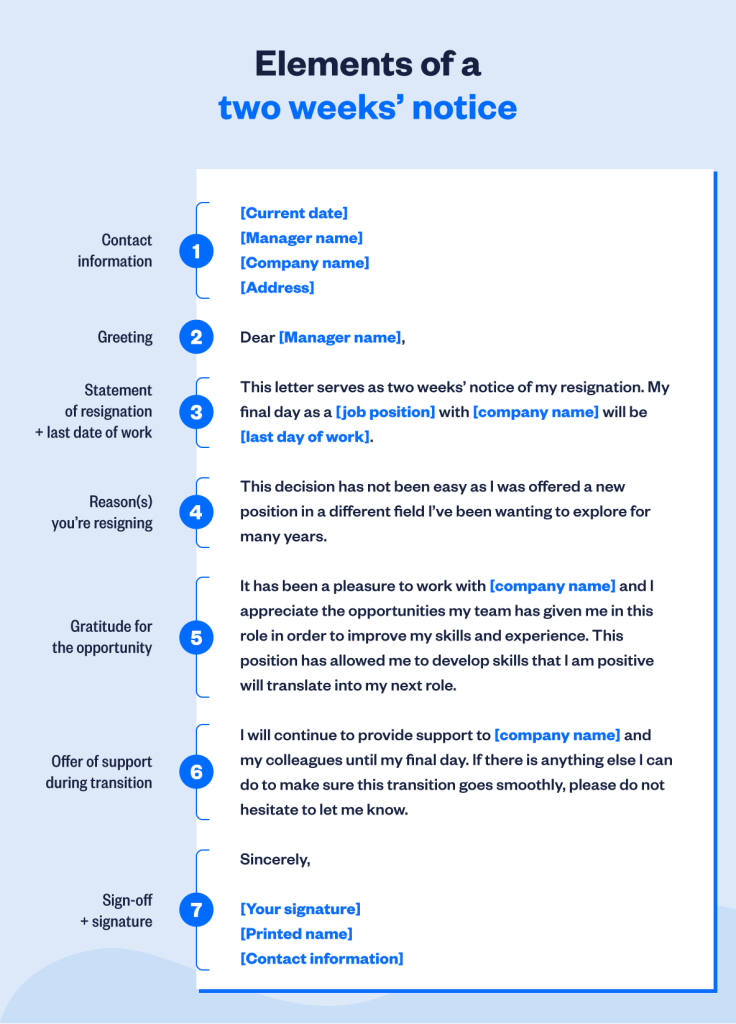
How to Write a Resignation Letter (AKA: Two Weeks Notice Letter)
1. Start with a formal header
Include your name, address, phone number, email, and the date. Then add your employer’s name and company address.
2. Address your manager directly
Use a formal salutation like “Dear [Manager’s Name],” to keep it professional.
3. Clearly state your intention to resign
In the opening paragraph, mention your position and the date of your last working day (typically two weeks from the date of the letter).
Example: “I am writing to formally resign from my position as [Job Title] at [Company Name], effective [Last Working Day].”
4. Express gratitude
In the next paragraph, thank your employer for the opportunity, experience, or support you’ve received.
5. Offer to help with the transition
Briefly mention your willingness to assist with training or handover tasks to ensure a smooth transition.
6. End on a positive note
Close with a professional sign-off like “Sincerely” or “Best regards,” followed by your name.
Source: wellfound.com
Example of a two weeks notice letter
[Your Name]
[Your Address]
[City, State, Zip Code]
[Your Email Address]
[Your Phone Number]
[Date]
[Supervisor’s Name or HR Representative]
[Company Name]
[Company Address] [
City, State, Zip Code]
Dear [Supervisor’s Name or HR Representative],
I am writing to formally submit my resignation from my position as [Your Position] at [Company Name], effective [Date of Resignation], providing the customary two weeks’ notice period.
It has been a privilege to be part of the [Company Name] team for the past [Duration of Employment]. I am sincerely grateful for the opportunities I have been given and the support I have received during my tenure here. The experiences and skills I have gained have been invaluable, and I am proud of the contributions I have made to the [Department/Team/Project].
While I am excited about the next chapter in my career, I want to assure you that I am fully committed to ensuring a smooth transition during my remaining time with the company. I am available to assist in training my replacement, completing any outstanding projects, and documenting important processes to facilitate continuity in my absence.
I would like to express my gratitude to you and the entire team for your guidance, mentorship, and camaraderie. I have truly enjoyed working with each and every one of you and will cherish the memories and relationships formed during my time at [Company Name].
Please do not hesitate to reach out if you require any further information or assistance during this transition period. I am more than willing to help in any way I can.
Thank you once again for the opportunities and support extended to me during my tenure at [Company Name]. I wish the company continued success and prosperity in the future.
Sincerely,
[Your Name]
Example of two weeks notice email
Subject: Formal Resignation – [Your Name]
Dear [Supervisor’s Name or HR Representative],
I hope this email finds you well. I am writing to inform you of my decision to resign from my position as [Your Position] at [Company Name], effective [Date of Resignation]. Please find attached my formal two-week notice letter outlining the details of my resignation.
I want to take this opportunity to express my sincere gratitude for the opportunities and support I have received during my time at [Company Name]. It has been a pleasure working with such a talented and dedicated team, and I am grateful for the experiences and growth opportunities that have come my way.
I am committed to ensuring a smooth transition during my remaining time with the company. If there are any specific tasks or projects that you would like me to prioritize or any assistance you may require, please don’t hesitate to let me know. I am more than willing to help in any way I can to facilitate a seamless handover of responsibilities.
Once again, thank you for your understanding and support. I look forward to working closely with you over the next two weeks to ensure a successful transition.
Best regards,
[Your Name]
Summary of the best tips for writing a great two weeks notice letter
- Plan Ahead: Take time to consider your reasons for leaving and what you want to communicate in your letter.
- Be Clear and Direct: Clearly state your intention to resign and specify the effective date of your departure.
- Follow a Formal Structure: Use a standard business letter format, including a header, salutation, body paragraphs, and closing.
- Express Gratitude: Show appreciation for the opportunities and experiences gained during your tenure with the company.
- Stay Positive: Maintain a positive and professional tone throughout the letter, avoiding negativity or grievances.
- Offer Assistance: Express willingness to assist during the transition period by training your replacement or completing pending tasks.
- Proofread Carefully: Review your letter for errors and ensure the tone is appropriate before finalizing and sending it.
- Deliver Personally: Ideally, hand in your letter in person and follow up with a respectful conversation about your resignation.
- Maintain Professionalism: Remember to end the letter with a formal closing and your signature to signify professionalism and respect.
- Keep a Copy: Make a copy of your letter for your records before submitting it to your employer.
Navigating the Transition Period – After Giving Notice but Before Your Last Day
Additionally, the two weeks notice letter serves as a buffer during which you can assist in the transition process. Offering your support and cooperation demonstrates your commitment to ensuring a smooth handover of responsibilities, which reflects positively on your professionalism and work ethic.
Research conducted by the International Journal of Human Resource Management has shown that organizations with well-structured transition plans experience fewer disruptions and maintain productivity levels during periods of employee turnover (source). By outlining the specific ways in which you can contribute to this transition—whether through training your replacement, completing pending tasks, or documenting essential processes—you enhance the likelihood of a seamless transition and leave a lasting positive impression on your employer.
Cultivating Positive Relationships
Beyond the immediate logistical considerations, a two-week notice letter also plays a role in nurturing long-term relationships within your professional network. Regardless of your reasons for leaving, maintaining a positive and amicable tone in your resignation letter can leave the door open for future opportunities and references.
Studies have shown that a significant percentage of job opportunities arise through networking and referrals. By parting ways on good terms and expressing gratitude for the opportunities and experiences gained during your tenure, you lay the foundation for potential future collaborations or recommendations.
Conclusion
In summary, a two-week notice letter serves as more than just a formal resignation; it’s a reflection of your professionalism, consideration for your employer, and commitment to facilitating a smooth transition. By approaching the process with clarity, gratitude, and a willingness to assist, you not only leave a positive impression but also maintain valuable connections that may benefit your career in the future.